


Gateway to the Marais Poitevin, located between land and ocean, between Vendée and Charente-Maritime, the town of Marans is full of surprises. Its marina, the astonishing bell tower of its church, its 19rd, its flower gardens or even its hen and its brown eggs are all curiosities to discover...
Here, we take our time. Far from the crowds, we get closer to the essential. Randomly in an alley, we notice a detail of the architecture, we redo the scenes of history and we imagine ourselves to be an adventurer of modern times. Focus on one of our country towns attached to its river: the Sèvre Niortaise.
The opinion of the local counter
We love to go on the water in paddle or kayak from Marans! We then discover an incredible image of the city, very different from that which we see while walking through the alleys. And it's usually the occasion for good laughs and wonderful memories...

A city connected by a canal to the sea
Marans comes from “mar'an” which means “place of the sea”. Located between the Baie de l'Aiguillon and the wet marsh, it offers the prospect of beautiful river and maritime walks. Piers allow you to navigate on the Sèvre Niortaise, and to discover the city from the water!
Marans is connected to La Rochelle by a 24 km long canal, along which you can walk or cycle to discover the many hydraulic structures, in particular the locks of Marans, Andilly or Rompsay.
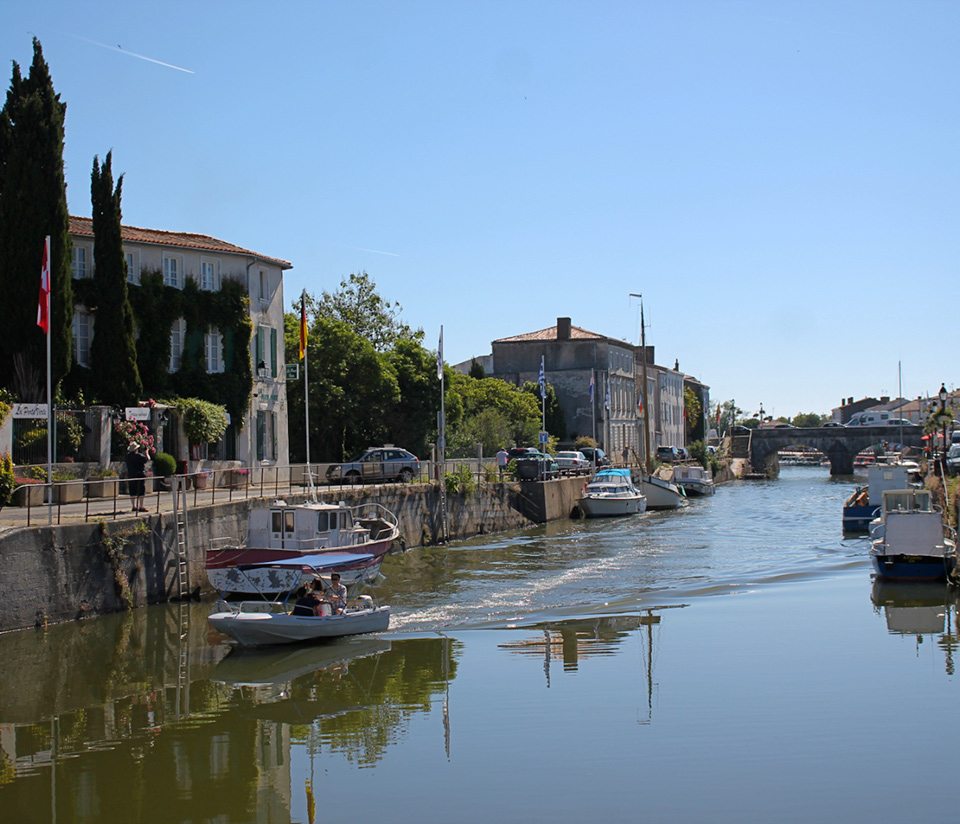
Marans piers
Between Marans and its river, it's a great love story...
The Sèvre Niortaise has its source in the department of Deux-Sèvres and crosses the town of Marans from east to west. Backbone of the Marais Poitevin, it forged the destiny of Marans as a river and maritime port. Many canals have therefore been dug; the two main ones are the maritime canal from Marans to the sea and the canal from Marans to La Rochelle.
From Marans, two piers, including that of Marais Plaisance, allow navigation on the Sèvre Niortaise. Here the navigation channels are wide and it is the boats without a license that are the most used. You can also rent canoes, pedal boats, kayaks and even stand-up paddles...
Zoom: can you go on a traditional boat in Marans?
In Marans, even if water is omnipresent, we are in the area known as the “dried marsh” of the Marais Poitevin. Here we sail on the Sèvre Niortaise and its wide navigation channels; the bottoms are too deep for the “pigouille”, the famous pole used to move the boats forward. We therefore favor small boats, canoes and paddles to discover the open landscapes of this little-known part of the Marais Poitevin... For those who wish to go on a traditional boat, we advise you to go to the wet marsh sector, more often called Green Venice. It is in this sector that you will find small canals bordered by trees and numerous piers which will offer you traditional boat trips. From Marans, the first landing stage is that of the Bazoin locks.
Walk in Marans
The centre, the quays and its marina
A stroll along the quays is a must for anyone who wants to feel the soul of the city. Don't miss the picturesque passage under the old stone bridge before following the canal towards the marina.
Get away from the water, just long enough to admire the market and the fish market by taking the rue des halles on your left. Some small streets of Marans will surprise you with their character and their timeless atmosphere.
Take the course of the water, to the port which was once very important for the traffic of cereals, fruits and vegetables but also for trade with foreign countries for the transport of spices, coal or wood. It is now a pleasant marina, which can accommodate up to 180 yachtsmen. Located in the city center, it provides Marans with a place of tranquility appreciated by visitors and Marandais themselves.
City and Flowered Village "3 flowers" and Healthy Earth "3 butterflies" due to the absence of pesticides, Marans is also a green and colorful city!
Among the green spaces of the city, the gardens of the town hall are particularly remarkable. They concentrate more than 300 unusual species for harmony over the 4 seasons.
Further on, at the exit of the city, the Bois Dinot is a wooded setting in the city. It now houses the municipal campsite, but remains accessible to all from 9 a.m. to 18 p.m. A botanical route signposted over 1,5 ha will allow you a pleasant walk on the theme of “the senses and the essences”. This 1h30 course will allow you to discover many varieties of trees and plants of the marsh.

Zoom
2 discovery trail offer you walking tours through Marans! A free booklet to be collected from one of our local counters.
Terra Aventura
For a fun visit, explore the alleys and every corner of the market town with “Tèrra Aventura”. You will then pass in front of buildings that have made the history of Marans: the Notre-Dame church which overlooks the town with its atypical bell tower, the covered market, the town hall and its flower gardens... and learn all about the famous Marans hen!
All you have to do is download the free “tèrra aventura” application on your smartphone, and let yourself be guided.
Marans, the Vélo Francette and the Vélodyssée
Due to its geographical location at the crossroads of two national cycle routes, Marans is a stopover of choice for cyclists looking for a little rest. It is also an ideal vacation spot for exploring the various cycle routes of the Marais Poitevin.
La Vélodyssée will take you south to reach La Rochelle along the canal and north to discover the Vendée coast after reaching the Brault locks.
La Vélo Francette will offer you a ride along the water, a link between the landscapes of the dry marsh and those of the wet marsh. To sample a bit of this itinerary, set off from Quai Maréchal Joffre in the direction of Taugon.

Once upon a time Marans…
Originally the sea
Around 200 years with JC, the sea covered a large part of the current Marais Poitevin which is called the Gulf of Pictons, this marshy delta of the Sèvre Niortaise.
Over time, the Gulf of Pictons fills up and many islets appear at low tide. Marans was born on one of these limestone islets, a land of refuge within an immense swamp. From the first centuries, men took advantage of the site to defend the Sèvre estuary.
From wet swamp to dry swamp
Long before the year 1, canals were created to drain the territory and prevent flooding. These works are directed by the monks present in the gulf from the 000th century.
The marsh transformed to create the open landscapes known today as the parched marsh. Culture becomes a considerable source of income for the country.
Marans is one of the last towns located on the Sèvre Niortaise, before the mouth of the river on the Baie de l'Aiguillon. This situation gives it a strategic role both commercially and defensively.
A defensive and strategic role
In the 10th century, the town of Marans was organized around its castle and the Saint Etienne church.
Both a fortress serving to protect its inhabitants and a place of observation of the mouth of the Sèvre Niortaise, the Château de Marans fully assumes its defensive role.
La Rochelle, Protestant, needs Marans and its vast grain warehouses. But soon, the conflict between King Louis XIII and Marans ended in the surrender of the city, which then became an outpost of the royal guard during the siege of La Rochelle. Richelieu will have the castle razed in 1638 to prevent reformed troops from settling there after the departure of the royal troops.
A commercial city
Due to its still very strategic position, Marans rose quickly enough to become, little by little in the 17th century, the granary of Aunis and Bas-Poitou. All the productions of the surrounding fields dedicated to trade now transit through its port .
In the 18th century, Marans was the subject of all the attention and it was soon planned to link Marans and La Rochelle by a canal which would promote trade. Unfortunately this work takes so long that when this canal is finished, river navigation is on the decline, competed by the railway.
Throughout the 19th century and until the beginning of the 20th century, Marans will keep an important place within the port network of the Atlantic coast.
In addition to its port, the city has been embellished over time, and has modernized its public spaces.
After the Second World War, the commercial port of Marans declined. On the one hand, it faces competition from the port of La Pallice located in La Rochelle, but on the other hand has difficulty in welcoming ever larger ships into its port. It then becomes a port reserved for yachting, not far from the ocean.

